
Two Machines, One Estimate: Comparing Hardware Before You Buy
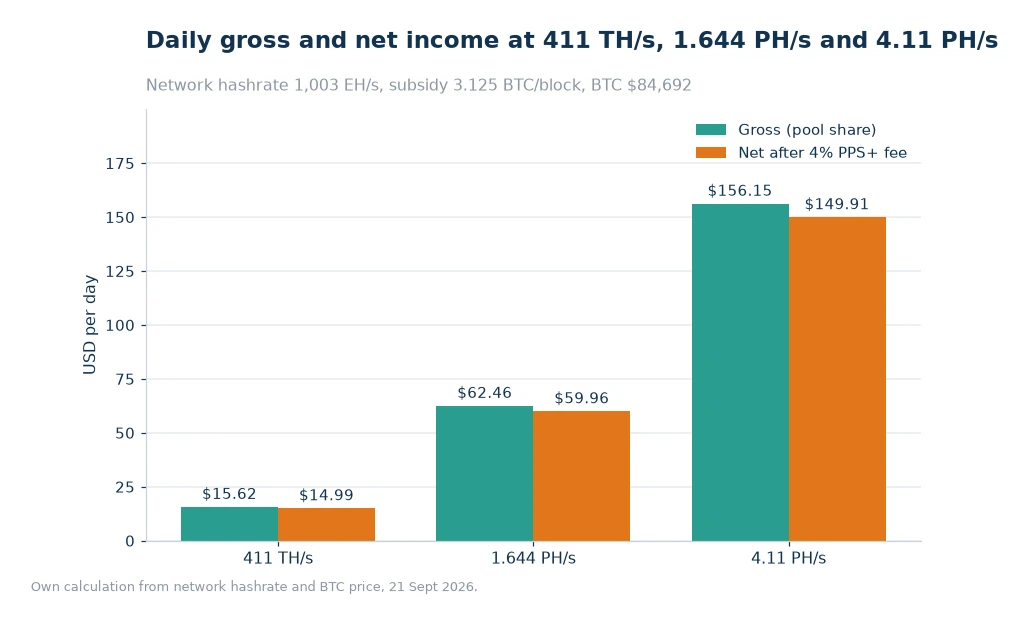
Two miners with the same headline hashrate can be a very different purchase. At 411 TH/s the daily credit is 0.00018438 BTC, or $15.62 at $84,692 per coin, and $14.99 after the listed 4%. At 20 joules per terahash and $0.06 per kilowatt-hour the power bill is $11.84, leaving $3.15 a day. That margin, not the terahash figure, is what a purchase price has to be divided by.

Key takeaways
- At 411 TH/s the gross credit is 0.00018438 BTC a day, or $14.99 after the listed 4%.
- A 20 J/TH unit at $0.06/kWh spends $11.84 a day on power, leaving $3.15 of margin.
- At $3,400 a machine, that margin implies roughly 1,079 days to recover the purchase price.
- A four-joule efficiency gap moves the payback by more than a fee-tier argument ever will.
Compare the margin, not the terahash
A specification sheet lists hashrate and efficiency and leaves the subtraction to the buyer. Hashrate determines revenue, efficiency determines the largest cost, and the difference is the only number that can be compared against a price. Two machines at 411 TH/s with different efficiencies do not compete on equal terms even if the seller quotes the same terahash figure in bold.
The comparison is also where most purchase mistakes happen. Buyers anchor on price per terahash, which is a reasonable shorthand when power is cheap and a misleading one when it is not. At $0.06 the gap between 18 and 22 joules is $2.37 a day, which is more than three quarters of the margin on the less efficient unit. In a market where power costs $0.09, that same gap is the difference between a machine that runs and one that does not.
Payback, with the arithmetic shown
The table uses three units with identical hashrate, different efficiencies and different prices. Every row uses the same credit, $14.99 after the listed 4%, so the only variables are the meter and the invoice. Payback is the purchase price divided by the daily margin, before hosting and any repairs.
| Unit | Power per day | Margin | Payback at price |
|---|---|---|---|
| 18 J/TH, $4,200 | $10.65 | $4.34 | 968 days |
| 20 J/TH, $3,400 | $11.84 | $3.15 | 1,079 days |
| 22 J/TH, $2,600 | $13.02 | $1.97 | 1,320 days |
The cheapest unit has the longest payback, which is not the answer most buyers expect. It is also not a universal result: at a lower tariff the efficient machine's advantage shrinks, and at a higher one it grows fast. Run the table with your own price and your own electricity rate before treating any row as advice. The structure is what travels, not the numbers.
What the payback number hides
Simple payback treats difficulty as fixed and repairs as zero. Both assumptions flatter every row. Difficulty has been rising over time, which shortens the revenue side of the fraction, and a fan or a hash board is a real cost that arrives without warning. A payback figure should be read as an optimistic case with a clean site and a stable network, not as a schedule.
The other omission is resale. A machine that is two years old still has a market, and its residual value shortens the effective payback if the plan includes selling. That is not a reason to buy on the assumption of a strong resale market, which can disappear, but it is a reason to keep the purchase price and the model year in the same note. The ViaBTC Mining Calculator will give you the revenue line for any candidate; the resale line is your own judgment.
Worked example
Follow one row from network output to payback.
- Daily network output: 3.125 BTC × 144 blocks = 450 BTC.
- Output per TH/s: 450 ÷ 1,003,107,267 = 0.000000448606 BTC.
- At 411 TH/s: 411 × 0.000000448606 = 0.00018438 BTC.
- In dollars: 0.00018438 × 84,692 = $15.62.
- After the listed 4% on the block-reward component: 15.62 × 0.96 = $14.99.
- Power at 20 J/TH: 411 × 20 = 8,220 W, × 24 = 197.28 kWh, × 0.06 = $11.84.
- Margin: 14.99 − 11.84 = $3.15. Payback at $3,400: 3,400 ÷ 3.15 = 1,079 days.
- The same unit at 18 J/TH: 177.55 kWh, $10.65, margin $4.34, payback 968 days at $4,200.
Note how little the fee matters in this comparison. The listed 4% costs $0.63 a day, while the four-joule gap between the first and last rows costs $2.37. Fee shopping is worth doing, but it is a much smaller lever than the efficiency of the hardware, and it is the lever that cannot be changed after delivery.
New, used and the middle ground
Used hardware usually wins on payback and loses on risk. The price is lower, the efficiency is worse, and the remaining life is unknown. A unit with a warranty and a service history is worth a premium; one sold as seen from a closing farm is a different proposition. The arithmetic can compare them, but only if the used price includes an allowance for a board replacement somewhere in the first year.
There is also the hosting question. A machine that is cheap to buy but expensive to run may make sense in a facility with a low tariff and no sense at home, where the same machine heats a room and competes with a domestic supply. The Mining Farms listing is where that comparison starts, since the tariff and the service level are the two variables that decide whether the efficient unit or the cheap one wins.
Run both candidates through the Profit Calculator at your own tariff before you commit, and do it twice, once at the price you expect and once at a price a tenth lower. A purchase that only works in the first case is a bet on the market rather than a decision about hardware, and the second case is the one that keeps you solvent through a quiet quarter.
When to replace rather than add
Adding a machine increases revenue and cost in proportion, which improves nothing about the existing fleet. Replacing an old unit with an efficient one improves the margin on the same hashrate, and that is often the better use of capital once the fleet is already at the size the site can support. The signal is an old machine whose margin has fallen to a fraction of a newer unit's.
The comparison is the same table with different rows: current margin, new margin, price, and the difference in power draw. If the new machine's extra margin repays its price before the old one would have failed anyway, the replacement is arithmetic rather than ambition. If it does not, the old machine is still earning, and earning is not the same as being modern.
Frequently asked questions
How do I compare two miners with the same hashrate?
Use the margin: at 411 TH/s the credit is $14.99 after the listed 4%, so an 18 J/TH unit at $0.06/kWh keeps $4.34 a day and a 22 J/TH unit keeps $1.97.
What is a reasonable payback period for mining hardware?
It depends on price, tariff and difficulty, but the arithmetic is simple: at a $3.15 daily margin a $3,400 machine takes about 1,079 days, before hosting and repairs.
Should I buy the cheapest machine or the most efficient one?
Compare payback rather than sticker price: a $2,600 unit at 22 J/TH takes 1,320 days at $0.06/kWh, while a $4,200 unit at 18 J/TH takes 968, and a higher tariff widens that gap.
Price the meter before the machine
Start with the tariff you can actually get, then choose the efficiency that makes sense at that tariff, then look for the machine. Doing it in that order removes most of the guesswork, because the electricity price is the one input that does not move after the purchase and the one that decides every row of the table above.
Write the payback date on the invoice. When it arrives, check whether the assumption still holds: difficulty, price and uptime will all have moved, and the note is a better teacher than the memory of why the purchase seemed obvious. The Miner Hosting directory is useful if the plan depends on a third-party site, since the all-in rate there belongs in the same subtraction as the power bill.
Sources: the ViaBTC calculator, farms and companies pages for revenue estimates and hosting options[1]. Chain data read 21 Sept 2026: network hashrate 1,003 EH/s, difficulty 132.76 T, 3.125 BTC per block, 144 blocks a day, BTC $84,692. Published 22 Oct 2026; prices, tariffs and payback periods are illustrative.