
Sterling Silver Jewelry Manufacturing: Hallmark Guide
A hallmark is a two-line fact printed in metal: what the piece is made of, and how precisely the workshop can repeat that claim. The published marks are an S925 stamp, 316L for stainless steel and an 18KGP mark on plated work for gold-plated work, all applied by high-precision laser engraving. Get the mark wrong and the MOQ, the plating spec and the retail story all stop matching each other.

Key takeaways
- Published hallmarks are S925 (sterling silver), 316L (stainless steel) and 18KGP (18K gold plated), laser-engraved after finishing.
- Floors are 100+ in the stainless line, 100 units in eco-brass plus 50 pieces in the silver line, by design, with every extra design adding the same quantity again.
- A hallmark states the base metal, so it has to be chosen before sampling, not engraved on a finished run.
- REACH covers lead, cadmium and nickel; plating is also stated as REACH and CA Prop 65 compliant.
What each hallmark actually claims
S925 means the piece is 92.5% silver by weight, the standard alloy used in jewelry. 316L is a stainless grade, chosen for pieces that meet skin and water daily. 18KGP describes a gold-plated article. None of the three says anything about stone quality, plating longevity or the standard of the polish — they describe the metal underneath.
That matters when the mark is used as a selling point. A shop assistant reading S925 off a tag is confirming the alloy, and a customer who tests the claim is testing the alloy too. Keep the claim the mark makes and the claim your copy makes identical.
Why marking happens after finishing
Laser engraving is one of the six published customisation options and it runs late in the build, after the surface stage and the plating tank. Engrave before polishing and the mark fills with metal dust; engrave before plating and the plated layer covers it. Position matters as much as timing: an inner band, a clasp or a pendant back takes a mark without competing with the design.
Because the laser is precise, it can also place a brand's own logo in the same pass. Two marks on one piece — a purity hallmark and a maker's mark — are normal, and both should be drawn on the CAD file so the placement is approved with everything else.
Silver orders carry four published details worth writing into the line sheet: every piece is stamped S925, the eco-conscious plating chemistry, kind to sensitive skin and an alloy free of nickel on a 925 base, and the site publishes ISO 9001:2015, BSCI and REACH compliance. Sample testing before production sits on the same page, which puts the alloy and the finish in front of a buyer before a batch exists.
Private label silver: what the buyer controls
A private label sterling silver jewelry order starts from your own line sheet rather than from a catalogue, which is why the six categories below are the fields that sheet has to fill. A private label order means the mark, the packaging and the paperwork carry your brand rather than the factory's. The published customisation list supports that directly: chains and findings, the packaging set, stones set as accents, plating and finishes, logo and hallmarks and the base metal. Six categories, all specified by the buyer.
What a private label buyer cannot change is the physical constraint underneath those choices. A 925 sterling silver design carries an MOQ of 50 pcs per design precisely because the material is quick to tool and cheap to finish. Choosing a heavier design does not change that number, and choosing a brass version moves it to 100.
Reading the minimum as a share of the brass minimum
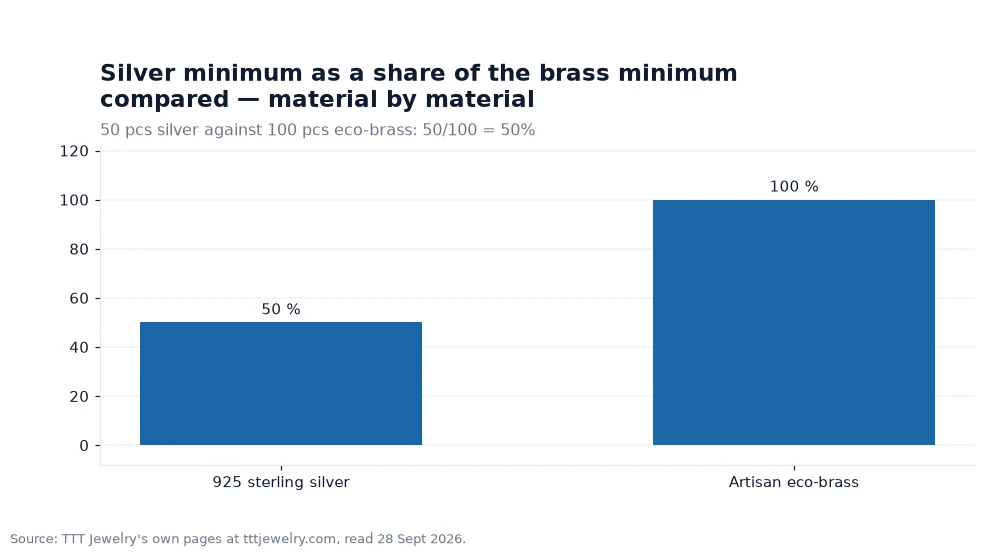
The gap between silver and brass is a factor of two: 50 pcs against 100 pcs. Expressed as a share of the brass floor, the silver minimum is 50 ÷ 100 = 50%. That single ratio explains most of the advice about first orders — a brand can open with twice as many silver designs as brass designs for the same unit commitment.
Stainless steel sits with brass at 100+ pcs per design, which is why it is rarely the material a brand starts on, even though PVD vacuum plating gives it real advantages for daily-wear lines.
| Item | Published figure or mark | What it fixes in your order |
|---|---|---|
| Sterling silver hallmark | S925 | Base metal, priced as 92.5% silver |
| Stainless steel hallmark | 316L | Grade for daily-wear pieces |
| Gold-plated hallmark | 18KGP | Declares the plated layer, not a solid alloy |
| Sterling silver minimum | 50 pcs per design | Opening order size for a silver design |
| Artisan eco-brass minimum | 100 pcs per design | Doubles the commitment for the same design |
Worked example: planning designs around the 50% ratio
Set a unit commitment of 200 pieces for a debut range and see what the marks allow. In stainless work, sterling silver at 925 and eco-brass, 200 ÷ 100+ is under, so a two-design range doubles those figures.
Reverse it for a marketing plan: four brass designs need 4 × 100 = 400 pieces, and the same four in silver need 200 — half the metal commitment, and every piece carries the S925 mark rather than an 18KGP mark over a base metal. That arithmetic is mine; the 50 and 100 figures and the three hallmarks are published.
Compliance language that belongs on the page
The materials statement published is REACH compliance for lead, cadmium and nickel, and the plating is described as compliant with REACH and CA Prop 65. Those are material statements, not product certifications, and they should be repeated in exactly that shape on your own product pages.
Add the quality system separately: ISO 9001:2015 covers the management of the production process, and a BSCI audit covers labour and site conditions. If a retail partner wants the full compliance pack, those three documents are the file, and nothing beyond them is published.
Where the mark sits on a finished piece
Placement is a design decision that the laser makes convenient and the bench makes permanent. On a ring, the inner band takes the purity mark without touching the visible face. On a pendant, the back side or the bail. On a bracelet, the clasp body, where the mark is felt rather than seen. A mark on a visible gloss face will always read as a scratch, however neatly it is cut.
Pair the purity mark with the maker's mark and keep the two consistent across every design in the range. A buyer photographing stock for a marketplace listing will show whatever is legible, and two different marks on two versions of the same design is the kind of detail that ends up in a review.
Depth is the other variable worth stating in the spec. A shallow laser pass survives polishing but can look faint on a satin surface; a deeper pass holds its edge but takes longer per piece. Because engraving runs as a single published stage for the whole order, the depth decision applies to the batch, not to individual pieces.
Frequently asked questions
Can a hallmark be added to an order later?
No. The mark is laser-engraved after finishing, and the purity mark has to match the base metal chosen for sampling, so it belongs in the CAD drawing rather than in a change request after the sample.
What does 18KGP mean on a brass or silver piece?
It declares 18K gold plating rather than a solid gold alloy, which is why plated work is also required to state its base metal separately.
Which mark applies to a stainless steel design?
316L, applied to a design with an MOQ of 100+ pcs per design and finished with PVD vacuum plating rather than a gold or rhodium electroplate.
Choosing the mark before the mould
Hallmarks are cheap to engrave and expensive to get wrong, because the mark is tied to the material decision that sets the minimum. Decide the alloy, decide the plating, then decide where the mark sits — in that order, while the CAD drawing is open.
A private-label programme makes that sequence straightforward, since the purity mark, the brand mark and the retail packaging are all specified by the buyer on one sheet. If your plan also includes plated lines, the wholesale ordering route explains how minimums combine across materials in a single purchase order, and the factory production steps show where the laser engraving stage falls in the build.
Where the numbers come from — the S925 stamping and the eco-friendly electroplating plus the approved-sample benchmark — is the brand's own pages over at tttjewelry.com, in a visit dated 28 Sept 2026. The three-way comparisons of minimums are my own arithmetic rather than the manufacturer's[1].