
ODM is the right route when the brand knows the shelf but not the scent, and it is the wrong route when the scent is the reason the product exists. Drugstore own-brand programmes sit mostly in the first category, which is why ODM works well for them: the retailer brings distribution, price architecture and customer knowledge, and the partner brings formulation, pack and production. The decision still deserves a checklist, because the conditions that make ODM efficient are specific and can be tested before a contract is signed.
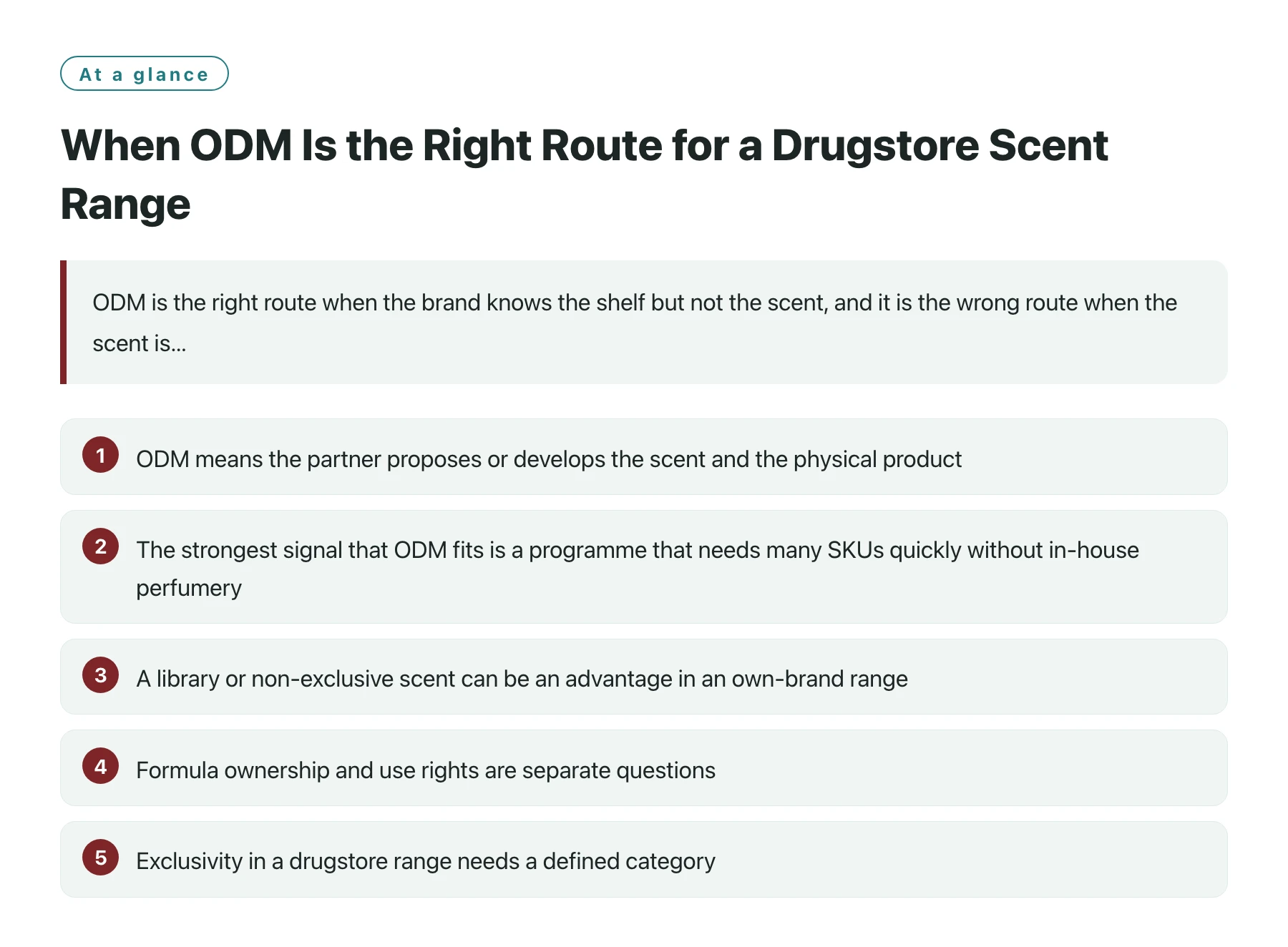
Key takeawaysODM means the partner proposes or develops the scent and the physical product, while the brand owns the retail position, the branding and the customer relationship. · The strongest signal that ODM fits is a programme that needs many SKUs quickly without in-house perfumery, rather than one hero scent that must be unique. · A library or non-exclusive scent can be an advantage in an own-brand range, because it shortens development and spreads cost across a larger volume. · Formula ownership and use rights are separate questions, and ODM agreements often grant rights to use a scent without transferring the composition [1]. · Exclusivity in a drugstore range needs a defined category, territory and duration, or it protects nothing once the range expands [1]. · Compliance obligations that come with placing a cosmetic on the market stay with the brand, even when the formula comes from the partner [2].
Drugstore own-brand fragrance has a particular shape. It is usually sold at a small number of price points, it competes on value and availability rather than on artistry, and it is expected to refresh often enough that the shelf does not look stale. A scent range built for that environment is closer to a packaging programme than to a perfume launch, and that is precisely the environment ODM was designed for.
The failure mode is committing to ODM for the wrong reason. Some buyers choose it because it sounds faster, or because it avoids an argument about briefs, and then discover that the range has no reason to exist once it is on shelf. The checklist below is about separating a genuine fit from a shortcut.
What the ODM route actually hands over
In an ODM arrangement, the partner develops the product and the brand adopts it. The development may start from the partner's existing library, from a trend direction the partner proposes, or from a concept the brand supplies and the partner interprets. What distinguishes ODM from a custom development is who does the inventing and who carries the risk if the first direction does not work.
That division also decides where the brand's effort goes. Instead of managing a brief and a sample round, the brand spends its time on pack, price, planogram and customer communication. If those are the things the team is actually good at, the trade is a good one. If the team's strength is scent, the trade gives away the part that matters most.
It is worth seeing this in practice before committing to a range. A partner that develops and produces the scent a factory that develops and produces the scent will usually show how a library direction is adapted to a brief, and that demonstration is a better predictor of the working relationship than any capability document.
Six conditions that point toward ODM
- There is no perfumer in the buildingNot a consultant on call, but someone who owns the scent decision internally. Without that person, a custom development programme tends to stall at the sampling stage.
- The range needs breadth quicklySix or more SKUs across price points and use occasions is a volume of decisions that a small own-brand team cannot absorb in a traditional development cycle.
- The scent is not the differentiatorIf customers choose the range because of the price point, the format or the brand on the shelf, then spending on a bespoke composition buys less than spending on pack and promotion.
- Non-exclusive is acceptableA library direction that another retailer may also use is a real trade-off, and it is one that value-tier ranges often accept in exchange for speed and cost.
- The packaging is already brand-ledWhen the pack, the name and the artwork are decided internally, the partner's remaining job is formulation and production, which is where ODM is strongest.
- The refresh cycle is shortA range that changes twice a year needs a partner that can move a direction to production without a full development programme each time.
Fit signals, side by side
| Signal | Points toward ODM | Points toward custom development |
|---|---|---|
| Role of scent in the buying decision | Secondary to price, format or brand familiarity | The main reason a customer picks the product up |
| Internal capability | Sourcing and category management, no perfumery | A perfumer or a trained product team who can direct a brief |
| Number of SKUs in scope | Many, across price tiers | Few, with a strong point of view on each |
| Time available | A reset date that cannot move | A calendar that can absorb a longer development phase |
| Tolerance for a shared formula | Acceptable at the value end of the range | Not acceptable for a signature or premium tier |
| Where budget should go | Pack, promotion and availability | Composition, materials and evaluation |
Most own-brand programmes are a blend: ODM for the volume tiers, custom development for the one scent meant to carry the brand.
Ownership and exclusivity, settled before the brief
Two questions decide more of the commercial outcome than any price negotiation. Who owns the composition, and what rights does the brand have to use it. Ownership and use rights are distinct, and an agreement can grant broad rights without transferring ownership at all [1]. For an own-brand range that is often perfectly acceptable, provided the brand knows which of the two it is buying.
Exclusivity is the second question, and it only means something when it is specified. A useful exclusivity clause names the category, the territory and the duration, and says what happens when the term ends. A clause that says the scent is exclusive without those three elements tends to be unenforceable in practice and disappointing in negotiation.
It also helps to look at what the partner has developed for other brands, not to copy anything but to judge range. Reading brands Xuelei has manufactured for brands Xuelei has manufactured for as a portfolio, rather than as a highlight reel, shows whether the partner's strengths line up with the tier the range is aimed at.
Where own-brand programmes usually go wrong
The most common mistake is treating ODM as a way to avoid making decisions. The partner can propose a direction, but it cannot decide the price architecture, the customer, or which scents can sit next to each other without cannibalising one another. Those remain brand decisions, and a programme that defers them ends up with a range that is technically fine and commercially arbitrary.
The second is forgetting that the brand remains the party placing the product on the market. Labelling, allergen declarations and the product information expected by the destination market stay with the brand, even when the formula and the pack come from the partner [2]. A supplier can provide data; it cannot take over the obligation.
The third is skipping the transition from development to production. The steps behind a new fragrance brand the steps behind a new fragrance brand do not stop at the chosen direction. Scale-up, decoration and batch consistency are where an own-brand range either settles into a rhythm or becomes a permanent project.
A partner that supports OEM and ODM a manufacturer that supports OEM and ODM can be useful for exactly this reason. A range can start in ODM for speed and move selected SKUs to a more controlled route later, without changing supplier and rebuilding the pack from scratch.
A one-line test for the route decision: if the range would still work with a different scent in every bottle, ODM is probably enough. If it would not, the scent is the product and it deserves a development programme.
Sources
- WIPO — World Intellectual Property Organization —— The UN agency for intellectual property; resources on industrial design and patent protection relevant to product and packaging design.
- Cosmetics Europe —— The European trade association for the cosmetics and personal care industry, publishing guidance, positions and market information.
Frequently asked questions
Does ODM mean the brand has no say in the scent?
No. The brand still sets the direction, the price point and the customer, and it approves or rejects directions. What changes is who generates the composition and who carries the development risk when a direction does not work.
Is a non-exclusive scent a problem for a drugstore own brand?
It can be, and often is not. At value price points, speed and cost usually matter more than uniqueness, and customers rarely compare the composition against a competitor's. For a signature or premium tier, exclusivity is worth negotiating.
Who owns the formula in an ODM arrangement?
It varies, and it should be stated rather than assumed. Many arrangements keep ownership with the partner while granting the brand defined use rights. Those rights, and their territory and duration, are the part that matters commercially.
Can a range mix ODM and custom development?
Yes, and many do. Volume tiers use library or lightly adapted directions while one or two hero scents are developed properly. The mix needs a clear plan so that the hero scent is not accidentally duplicated by an ODM direction.
What should be decided before the first ODM brief?
Price architecture, pack format, the number of SKUs and which of them must be exclusive. Those four decisions shape every direction the partner proposes, and leaving them open produces a wide range of proposals that cannot be compared.